



The rising three methods pattern in forex is a commonly used continuation signal in uptrends, helping traders spot potential breakouts. Identifying consolidation within a strong trend may help traders find potential entry points, making it a useful tool for trend-following strategies.
This article will discuss the rising three-method pattern in depth.
What is the rising three methods pattern?
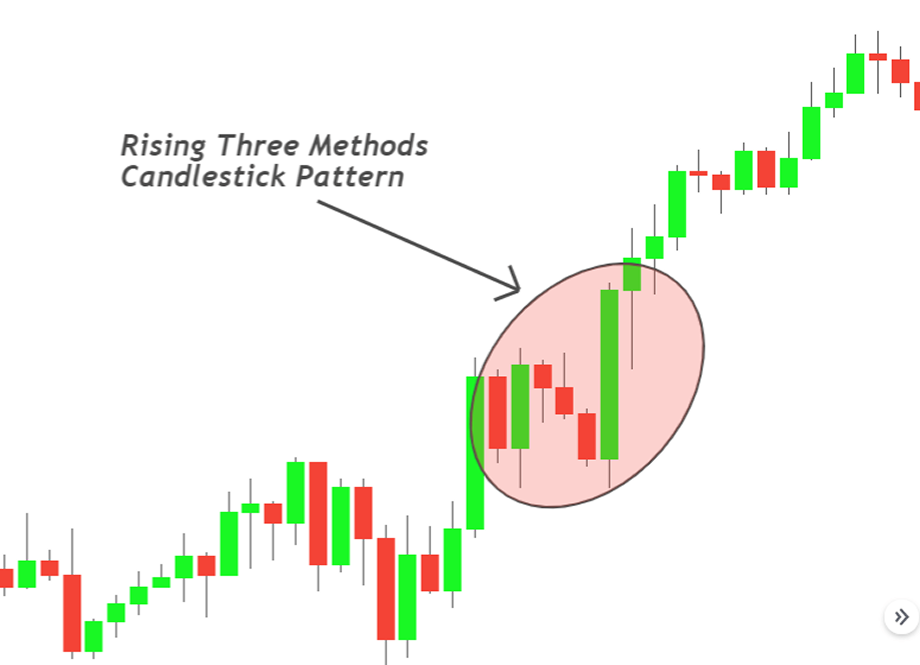
The rising three methods is a bullish continuation candlestick pattern used in technical analysis. It suggests that the current uptrend could potentially continue. Even though bears try to push the price down during the three small red candles, they fail to break the overall uptrend.
The pattern consists of five candles:
- First candle: A long bullish (green) candle showing strong entry/long momentum.
- Next three candles: Small-bodied bearish (red) candles that fall within the range of the first candle. These show a short-term pause or consolidation and not a reversal.
- Fifth candle: Another long bullish candle that closes above the first candle's close, confirming the continuation of the uptrend. This final strong green candle indicates that bulls are still in control and the upward momentum has returned.
How to identify the rising three methods pattern on a chart?
The following steps show a general method to identify the pattern and trade it in a hypothetical scenario. This is not personal advice, and you should make your own trading decisions.
- Identify the prevailing uptrend: Look for a strong upward movement in price before the pattern appears. This sets the stage for a continuation setup.
- Spot the three-bar consolidation: After a large bullish candle, you should see 3 (sometimes 2 to 4) small-bodied candles moving slightly downward or sideways. These are usually bearish or indecisive candles and typically remain within the range of the first large candle.
- Confirm the consolidation: Ensure that these small candles do not close below the low of the first big green candle. This suggests that the pullback is likely controlled and not indicative of a trend reversal.
- Watch for the breakout: The pattern completes when a strong bullish candle appears after the small candles, breaking above the first candle's high. This may indicate that buyers are gaining strength again.
- Check volume: Ideally, the volume should be lower during the consolidation and increase on the breakout candle, validating the strength of the move.
- Ensure market context: Always analyze this pattern in the broader market or sector context. Confirm it's not forming near major resistance or during low-liquidity hours.
Strategies to use with the rising three methods pattern
Target based on previous swing highs
The target-based strategy involves setting a gain target near the previous swing highs. Once the rising three-method pattern completes, traders may consider evaluating key resistance levels formed by prior highs. The rationale is that these highs are likely to act as barriers to further price movement.
By targeting these levels, one can ensure that they exit the trade before the price faces resistance and potentially reverses. This approach helps in taking a more conservative and risk-managed position, avoiding getting caught in a reversal after the breakout.
Momentum trading strategy
Momentum trading with the rising three methods pattern focuses on potentially profiting from the trend following the consolidation phase. To enhance the strategy, momentum indicators like the RSI (Relative Strength Index) or MACD (Moving Average Convergence Divergence) may be used to confirm the trend's strength.
If the RSI is above 50 (indicating bullish momentum) or the MACD shows a positive crossover, the trend may continue, which could support a trade in the breakout direction. This method allows traders to align with the prevailing trend, adding confidence to the position.
How to trade forex with the rising three methods pattern
-
Identify the pattern
To trade forex with the rising three methods pattern, first look for a prevailing uptrend in the market. The pattern begins with a strong bullish candle, followed by three smaller candles that consolidate within the range of the first candle. These smaller candles can be bearish or neutral.
After the consolidation, the market is expected to continue its bullish move, marking a good opportunity for a long position.
-
Confirm trend strength
Before entering the trade, confirm the strength of the trend. Use momentum indicators like the RSI or MACD to verify that the market is still in a bullish phase.
An RSI above 50 indicates strong bullish momentum, while a positive MACD crossover confirms the trend's continuation. This helps avoid entering trades against a weakening trend.
-
Wait for breakout
Once the trader has identified the pattern of the three rising methods and confirmed the trend's strength, wait for a breakout above the height of the first bullish candle.
A breakout may suggest that the consolidation is ending and the uptrend could resume. Enter the trade after the breakout candle closes above the high, confirming that the bullish move is intact.
-
Use volume analysis
Volume plays a crucial role in confirming the validity of the breakout. Ensure that the breakout candle has a higher volume than the preceding candles, indicating that market participants are supporting the move.
Low volume during the breakout may signal a false move, so always confirm the breakout with increased volume to ensure the trade has the strength to move in one's favor.
-
Place a long order
Once the breakout is confirmed with volume, traders may consider placing a long order at the close of the breakout candle. This ensures that the trader enters the trade after the price has confirmed its upward movement, reducing the risk of entering too early in case of a false breakout.
-
Set stop-loss
To manage risk, place a stop-loss just below the low of the consolidation phase (the three smaller candles). This acts as a protective net in case the market reverses against the trader.
The stop-loss helps minimize potential losses if the breakout turns out to be false and the price starts to decline.
-
Determine take-profit level
For the take-profit level, consider the previous swing high or resistance level as the target. The rationale is that price often struggles to break through previous highs, so it's a good place to lock in gains before the market potentially faces resistance.
Use the rising three methods pattern for trend continuation
The three rising methods signal potential continuation in uptrends, helping traders identify entry points and manage risk. It's effective in trending markets but may result in false breakouts in sideways or choppy markets. Additionally, volume and trend confirmation are crucial to reduce risk with this pattern.
Disclaimer: All material published on our website is intended for informational purposes only and should not be considered personal advice or recommendation. As margin FX/CFDs are highly leveraged products, your gains and losses are magnified, and you could lose substantially more than your initial deposit. Investing in margin FX/CFDs does not give you any entitlements or rights to the underlying assets (e.g. the right to receive dividend payments). CFDs carry a high risk of investment loss.