



The break and retest strategy is a price action technique forex traders use to confirm breakout levels before entering a trade. As with any leveraged product, margin FX/CFDs carry a high risk of loss and are only suitable for experienced traders. Instead of jumping in at the break out, traders wait for the price to pull back and retest the broken support or resistance.
The strategy helps filter out false breakouts and improves entry timing. Learning this strategy equips traders with better risk control, precision, and confidence, making it a commonly used technique for traders who prefer confirmation-based approaches.
Let’s discuss this in more depth below.
What is a break and retest strategy?
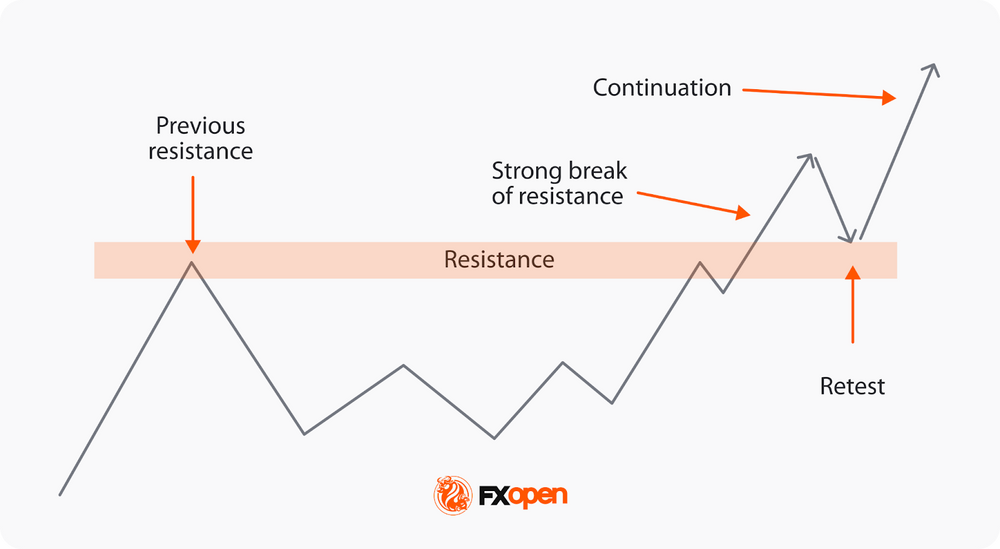
The break and retest strategy in forex is a price action technique where a trader waits for the price to break through a key support or resistance level and then retests that same level before entering a trade.
For example, if the price breaks above resistance, it often comes back to ‘retest’ the broken level, which now acts as support. If the level holds, traders enter a long position, expecting the uptrend to continue. This method helps confirm the breakout and reduces false signal risks.
How to use break and retest in different market conditions
Trending markets
In trending markets, the break and retest strategy helps confirm entries in the direction of the trend. For example, wait for the price to break above resistance during an uptrend, then retest it as support. Enter after confirmation of support holding. It allows traders to align entries with the existing trend, provided the retest shows signs of holding.
Range-bound markets
In range-bound conditions, this strategy works near the edges of the range. Wait for the price to break out of the range, then retest the breakout level. If the price holds, it confirms the breakout. Enter in the direction of the break with tight stop-losses.
Volatile markets
Fakeouts are common in high volatility. Use break and retest cautiously, waiting for strong confirmation, such as pin bars or engulfing candles at the retest point. Also, consider reducing position size or widening stop-loss to manage the risk of sudden spikes.
Consolidating markets
During consolidation, avoid early entries. Wait for a clean breakout followed by a retest of the consolidation boundary. If the retest holds, it often signals the beginning of a strong trend. Traders must be sure to act only after a strong breakout and retest confirmation.
High-impact news events
News can cause sharp price movements, making false breakouts more likely. Wait for the news impact to settle, then look for a break and retest setup. Confirmation is crucial, so one should only trade when the level holds after the retest, ideally with volume or candle signals.
Pros and cons of using the break and retest strategy
Remember that all positions using leverage carry a high risk of loss. Only trade with funds you can afford to lose.
Pros reduce false breakout risks
- Risk-reward ratio optimization: Since entries are made after confirmation, traders can place tight stop-losses and aim for higher rewards. This can improve overall trade efficiency
- Suitable for trend-following markets: It aligns well with trending conditions, helping traders enter trades with the momentum instead of against it
- Helps identify market sentiment: The strategy reflects whether the market accepts or rejects new price levels, giving insight into the strength of a breakout
- Reduces emotional trading: By following a structured approach, traders are less likely to enter impulsively and more likely to stick to a disciplined plan.
Cons
- Slow to respond in fast-moving markets: By waiting for confirmation, traders may miss quick moves or early entries
- Over-reliance on technical levels: The setup assumes key levels will always hold, which may not be true in all scenarios
- May lead to delayed entries: Confirmation adds protection but can also reduce gains if the price moves sharply after the retest
- Not always reliable in choppy markets: In sideways or erratic markets, breakouts and retests can be inconsistent and unreliable
Stepwise guide to trade forex with the break and retest strategy
Educational purposes only. This is not personal advice. Trading leveraged products like margin FX/CFDs carries a high risk of loss and is only suitable for experienced traders. Only trade with funds you can afford to lose.
-
Identify key support and resistance levels
Mark horizontal zones where the price has historically reversed or paused. These are potential breakout zones. Use higher timeframes (H4 or daily) for stronger levels that are more likely to attract price reactions.
-
Wait for the breakout
Watch for a strong candlestick close above resistance or below support, indicating that the level has been broken with momentum. Avoid entering right away and wait for the price to return to that level.
-
Wait for the retest
After the breakout, let the price pull back to the broken level. For a bullish breakout, the old resistance should now act as support. For a bearish breakout, the old support should act as resistance. This retest confirms whether the breakout is genuine.
-
Check price action for confirmation
Look for reversal signals like pin bars, bullish/bearish engulfing candles, or inside bars at the retest zone. These candlestick patterns confirm bulls’ or bears’ interest and reduce the risk of false breakouts.
-
Enter the trade
Once confirmation appears, place the trade in the direction of the original breakout. For a bullish setup, enter above the confirming candle’s high. For bearish setups, enter the confirming candle’s low below.
-
Set stop-loss and take-profit levels
Place the stop-loss just beyond the opposite side of the pin bar or confirming candle to protect against false moves. Set the take-profit at the next key support/resistance level, ensuring a minimum 1:2 risk-to-reward ratio.
-
Monitor the trade and adjust as needed
Track the trade closely, especially during news events. Consider moving the stop-loss to breakeven once the price moves in the trader’s favor. Traders can also scale out at partial gain levels to lock in gains while staying in the trade.
When, where, and why to use break and retest in forex
The break and retest strategy suits traders who value confirmation and structured entries. It can be applied in trending or post-consolidation markets to help traders assess potential breakout levels.
Traders may incorporate this method into their plan if they understand the risks involved. Margin FX/CFDs can amplify losses, and no strategy guarantees profit.
One should enter after the price retests the broken level and shows a strong reversal signal. As with any leveraged trading, outcomes may vary, and losses can exceed the initial deposit.
Disclaimer: All material published on our website is intended for informational purposes only and should not be considered personal advice or recommendation. As margin FX/CFDs are highly leveraged products, your gains and losses are magnified, and you could lose substantially more than your initial deposit. Investing in margin FX/CFDs does not give you any entitlements or rights to the underlying assets (e.g. the right to receive dividend payments). CFDs carry a high risk of investment loss.